


Cedars-Sinai Celebrates Class of 2024 at 12th Commencement Ceremony

36 Students Earned Degrees: 26 Masters in Health Delivery Science; Two Masters of Science in Magnetic Resonance in Medicine; and Eight PhDs in Biomedical and Translational Sciences
Forough Abbasi's name was the first to be called when the Cedars-Sinai Graduate School of Biomedical Sciences began conferring degrees at the recent 2024 Commencement. While Abbasi's pole position was arrived at alphabetically, it was fitting.
This was the first time she had ever walked in a graduation ceremony.
Born and raised in Rasht, Iran, Abbasi took her first steps onto U.S. soil in 2013, and here she was just steps away from receiving her Master's Degree in Health Delivery Science, and doing so as one of two students who received the Cedars-Sinai “Distinguished Student Award for Academic Excellence.”
Walking toward the stage, Abbasi was “nervous, making sure I wasn't falling off my heels and that I had placed my graduation sash the right way.”
Thomas M. Priselac, Cedars-Sinai president and CEO, welcomed guests to the 12th commencement ceremony at which 36 degrees were awarded: 26 masters in health delivery science; two masters of science in magnetic resonance in medicine; and eight PhDs in biomedical and translational sciences.
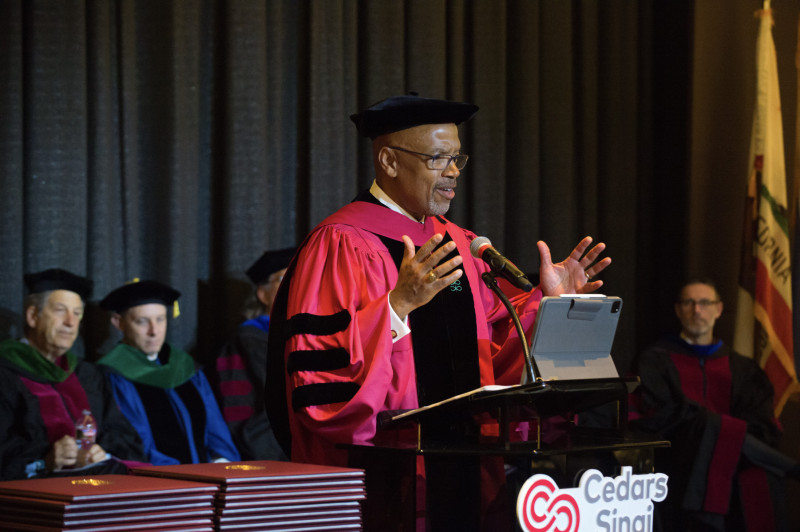 “There are many ways to contribute to society,” Priselac told the graduates. “The calling you've chosen is an indispensable one. You are pioneering breakthroughs and advancing innovative therapies that help patients on their healing journeys. You are an essential part of a profound connection: Your progress is our patient's progress.”
Henri R. Ford, MD, MHA, dean and chief academic officer of the University of Miami Leonard M. Miller School of Medicine gave the keynote address. A pediatric surgeon, Ford has conducted groundbreaking research, including studying necrotizing enterocolitis, a deadly gastrointestinal condition that affects premature infants.
“By the time you leave this auditorium, your lives will be forever transformed,” Ford told the graduates. “Your skills, dedication, commitment and compassion are needed today more than ever to find solutions to effectively confront many of the societal challenges posed by so many confounding illnesses that plague our aging population, as well as emerging pathogens that threaten health globally.
Members of the great class of 2024, as the principal architects of future groundbreaking scientific discoveries, I have boundless optimism that you understand and embrace our collective sense of social responsibility and will endeavor to improve the health of humanity.”
In her address, Class of 2024 Speaker Rebecca Benhaghnazar, who trained in the Medina-Kauwe Laboratory, said, “Each of us here today decided to focus on what happens at the most micro level. We go small; we focus on the cells. We know the odds are against us; uncertainty is built into the very nature of our work…In turn, what do we do? We take out our pipets, ready to trailblaze through, and we sit at our computers to analyze our data. We move forward one experiment after the other.”
Benhaghnazar concluded, “If we take small, yet significant steps with a wholehearted intention to contribute and care for others with integrity, in the long term, those efforts will be rewarded with success that is beyond what we could have imagined.”
Jeffrey A. Golden, MD, professor of Pathology and Laboratory Medicine, executive vice dean of Research and Education, and director of the Burns and Allen Research Institute, advised graduates to “challenge yourself. Explore novel concepts, take risks and look beyond your own expertise for inspiration. Aim for the surprising and the unpredictable. Take biomedical science somewhere new.”
Read More on the Cedars-Sinai Newsroom: Cedars-Sinai's NextGen Pathways—Guiding Future Healthcare Pros