


Not Immune to Clinical Excellence
Winners of the 2024 Clinical Fellows Award for Excellence in Research Investigate Ways to Moderate or Boost the Body’s Immune Response to Fight Heart Disease and Cancer
Cedars-Sinai clinical fellows investigating ways to boost or modulate the body’s immune response have been selected as winners of the 2024 Clinical Fellows Award for Excellence in Research. Their studies evaluated therapies to reduce organ rejection among transplant patients and improve survival for patients with pancreatic cancer.
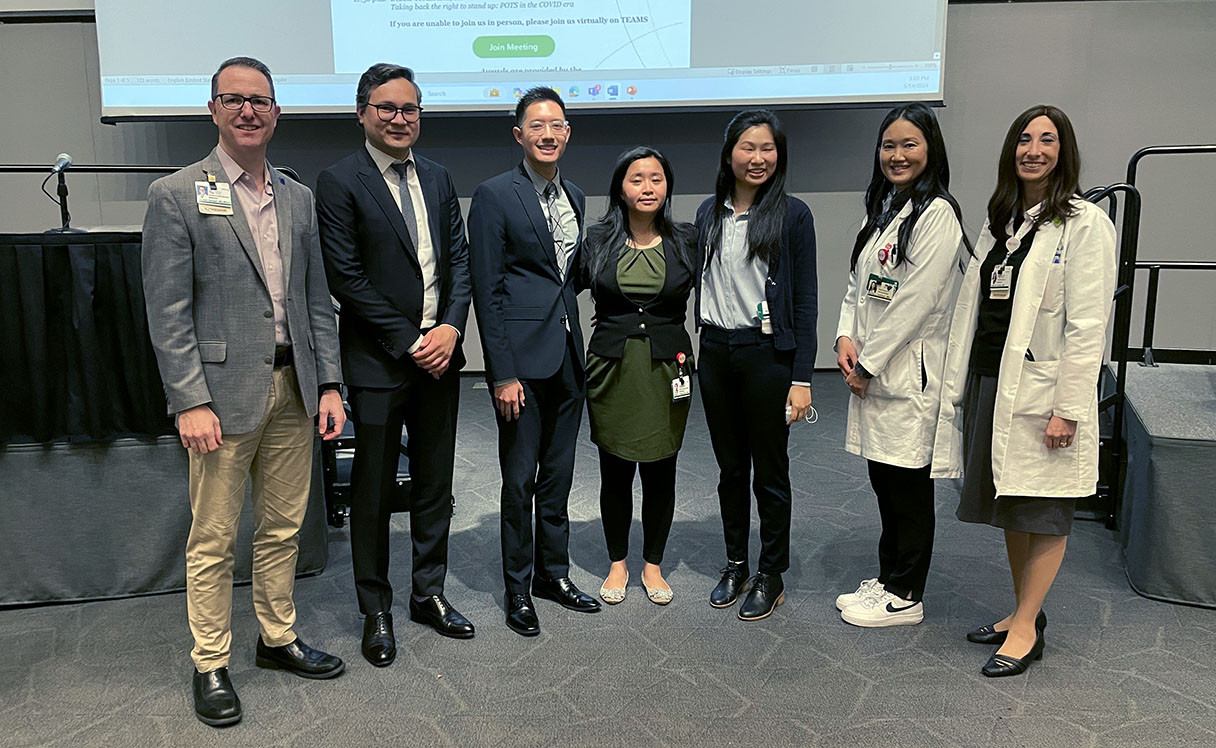
At a May 14 hybrid event, four finalists presented their work to a panel of judges, who later announced the two winners of the annual award.
“This award aims to foster clinical and translational research, enrich knowledge and encourage the development of our clinical fellows as investigators,” said Mariko Ishimori, MD, assistant professor of Medicine, committee chair for the Clinical Fellows Research Award Program and associate director of the Cedars-Sinai site of the UCLA Clinical and Translational Science Institute.
Akbarshakh Akhmerov, MD, a cardiac surgery fellow mentored by Eduardo Marbán, MD, PhD, executive director of the Smidt Heart Institute, received the award for his study “Long Non-Coding RNA From Extracellular Vesicles Enhances Regulatory T Cells.”
Akhmerov wanted to understand the mechanism through which cells called cardiosphere-derived cells (CDCs), heart-derived progenitor cells developed in the Marbán Lab, modulate the body’s immune response and could help prevent organ rejection in transplant patients.
“Many transplant patients are placed on immunosuppressive therapies that have serious side effects,” Akhmerov said. “There is always a push to find new ways to prevent rejection. The CDCs themselves have limitations because, as whole cells, the body’s immune system can recognize them as foreign and have an immune reaction against them.”
In his study, Akhmerov and collaborator Ke Liao, PhD, showed that tiny particles called extracellular vesicles, produced by the CDCs, boosted proliferation of regulatory T cells, which work to control immune response and inflammation. They then looked at the “cargo” of molecules carried by the extracellular vesicles and found that the most prevalent RNA molecules, called long noncoding RNA, were responsible for this effect.
“This is what will help move our work from bench to bedside,” Akhmerov said. “It is much more feasible to develop therapies based on small molecules, such as long noncoding RNA, than on whole cells, or even EVs.”
Akhmerov said that these therapies could be helpful not only for transplant patients, but also for patients with autoimmune and chronic inflammatory disorders.
“Dr. Marbán is an ideal mentor in that you get autonomy, but you also get a tremendous amount of guidance,” Akhmerov said. “This project wasn't something that the lab was working on at the time, but he was open to it and mentored me through it.”
Matthew Ebia, MD, a hematology-oncology clinical fellow mentored by Arsen Osipov, MD, program lead of the Cedars-Sinai Pancreas Cancer Multidisciplinary Clinic and Precision Medicine Program, received the award for his study “Exploring the Role of CXCR4 and Immunotherapy in Immune Cell Modulation in Pancreatic Cancer.”
Ebia and co-investigators sought to improve outcomes for patients with pancreas cancer by improving the immune system’s ability to penetrate these tumors.
“The microenvironment around pancreas cancer tumors blocks immune cells called effector T cells from entering and attacking them. That makes them resistant to immunotherapy,” Ebia said. “We’re seeking ways to get those effector T cells into the tumor to improve patient outcomes.”
Ebia focused on a protein called focal adhesion kinase (FAK), which keeps effector T cells out of tumors.
In an ongoing randomized Phase II clinical trial, Ebia compared biopsies from pancreas cancer patients who received chemotherapy and immunotherapy with those from patients who also received medication to block the action of FAK.
Preliminary results indicate that blocking FAK did increase infiltration of effector T cells into tumors, and pointed to the CXCR4 pathway as a potential immune resistance mechanism that can be targeted in future studies to improve patient outcomes.
Ebia, whose focus is on gastrointestinal oncology and hepatobiliary cancer, said that he would ultimately like to be a clinical trialist and clinical investigator who also sees patients.
“Working with Dr. Osipov has been a great learning experience because of the mentorship, but also the exposure to laboratory work and clinical trials,” Ebia said. “Pancreas cancer is very aggressive and there's a lot of work that needs to be done in this space, but we are slowly but surely making a difference.”
Ebia and Akhmerov each received a $3,000 cash prize funded by the Burns and Allen Research Institute at Cedars-Sinai and the Cedars-Sinai site of the UCLA Clinical and Translational Science Institute.
The two additional award finalists were Michelle Koh, MD, who presented “Improved Glucose Homeostasis With Hormone Replacement Therapy Use,” and Debbie Teodorescu, MD, who presented “Taking Back the Right to Stand Up: POTS in the COVID Era.”
Follow Cedars-Sinai Academic Medicine on X for more on the latest basic science and clinical research from Cedars-Sinai.