

Winners of 2024 Rubenstein Award for Excellence in Resident Research Named
Two Residents Honored With Top Prize During the Annual Series Encouraging Clinical and Translational Research
More than 30 years after Paul Rubenstein, MD, became Cedars-Sinai’s first director of Medical Education, his legacy lives on.
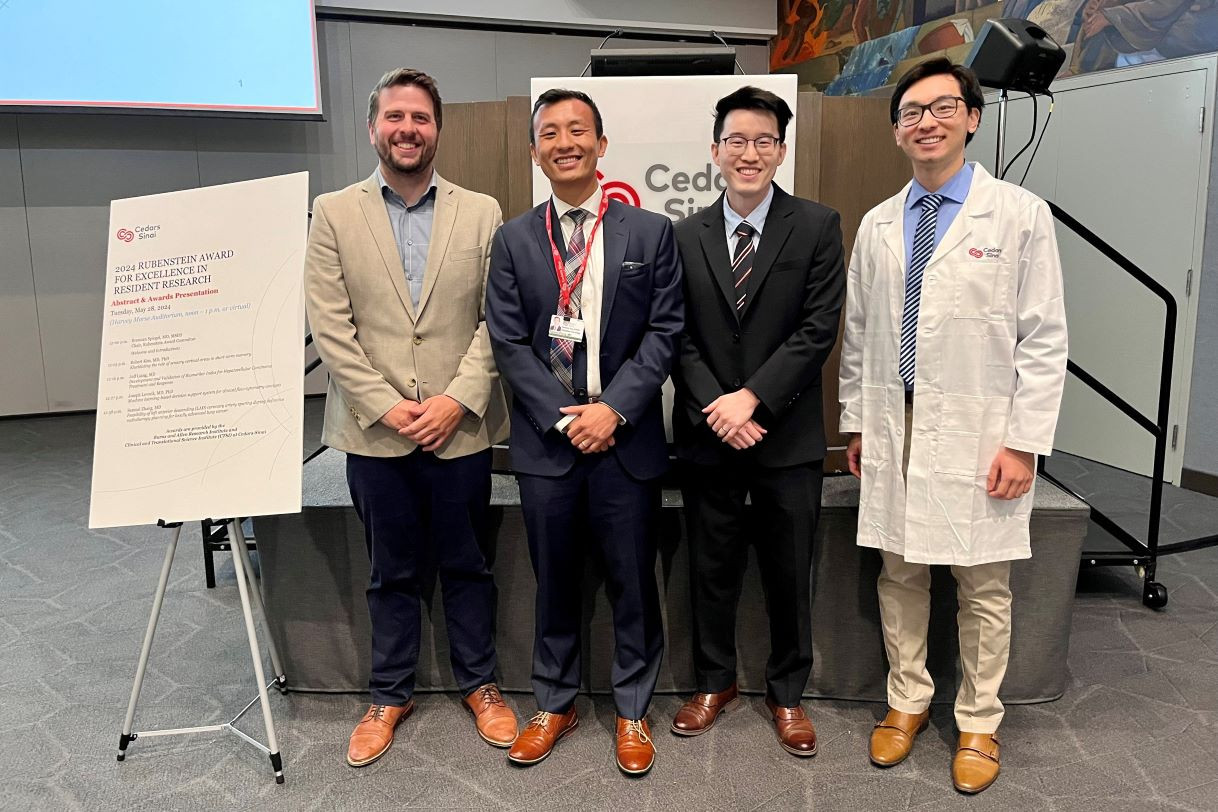
Last month, four Cedars-Sinai residents competed in his honor for the 2024 Rubenstein Award for Excellence in Resident Research. The award series—created when Rubenstein worked at Cedars-Sinai—honors Rubenstein’s efforts to transform the medical center from a community hospital to a major academic hub.
The award aims to foster clinical and translational research, enrich knowledge, and encourage the development of residents across Cedars-Sinai as investigators.
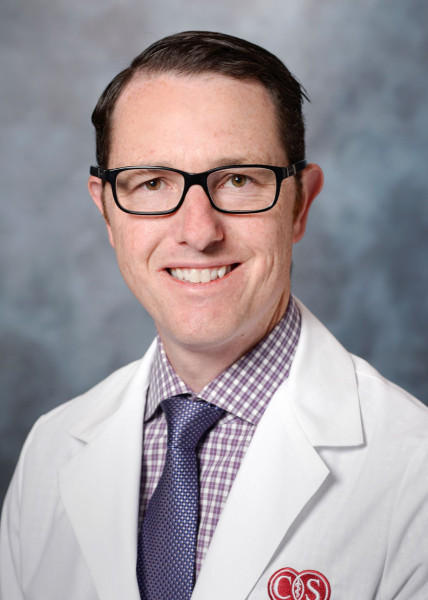 “This competitive opportunity for young trainees showcases the work they have been doing to catapult clinical and translational research—which was the mission of Dr. Rubenstein’s work,” said Brennan Spiegel, MD, MSHS, chair of the Rubenstein Award Committee, professor of Medicine and director of Health Services Research at Cedars-Sinai. “These residents are an integral part of our research enterprise, ensuring the best-quality ideas and innovations are studied.”
When he was a Cedars-Sinai resident in 2001, Spiegel competed for the Rubenstein Award. He took home first place.
The top four finalists who presented their work on May 28, 2024, were residents Robert Kim, MD, PhD; Jeff Liang, MD; Joseph Lownik, MD, PhD; and Samuel Zhang, MD. Each went through a rigorous application process prior to stepping up to the podium. Each competitor submitted an original study abstract as well as a letter of support from their primary mentor.
Lownik and Zhang took top honors, and each received a $3,000 cash prize.
Lownik’s research, titled “Machine Learning-Based Decision Support System for Clinical Flow Cytometry Analysis,” highlighted how investigators successfully implemented a pathologist-trained, artificial intelligence program to analyze clinical flow cytometry studies to help diagnose leukemia and lymphoma.
“As part of the physician-scientist training program in the Department of Pathology, research is a big part of my residency training, and Cedars-Sinai has been incredibly supportive of this project, and my mentor, Dr. Kitahara, has worked tirelessly on this project with me,” Lownik said. “This award is further validation of the importance of this work, as well as Cedars-Sinai’s commitment to improving patient care through the adaptation of artificial intelligence into the clinical workplace.”
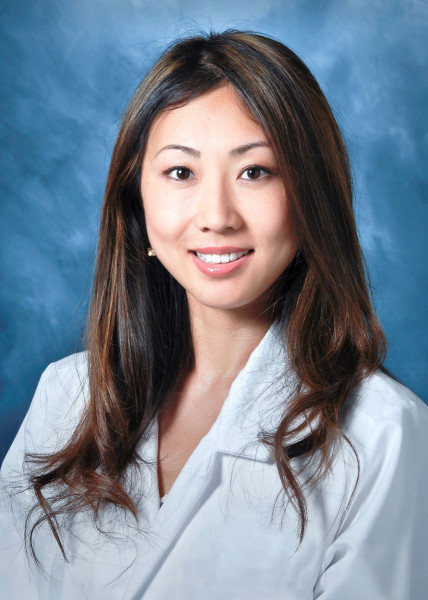 Sumire Kitahara, MD, associate professor of Pathology and Laboratory Medicine at Cedars-Sinai, said, “Being Dr. Lownik’s mentor has been incredibly rewarding, especially given the opportune timing to embrace machine learning in clinical medicine. While I had limited experience with computational tools to analyze high-dimensional data, Dr. Lownik’s research background and interest in hematologic neoplasms and clinical flow cytometry, combined with his innovative use of machine learning algorithms, allowed us to transition these research tools into clinical practice. This is particularly significant in hematopathology, where advancements in flow cytometry are producing complex data.”
The research focus of Zhang’s work is the “Feasibility of Left Anterior Descending Coronary Artery Sparing During Definitive Radiotherapy Planning for Locally Advanced Lung Cancer.” Zhang’s research is among the first to show that it is possible to drastically reduce radiation dose to critical parts of the heart—such as the coronary arteries, which supply the heart with blood and oxygen—without reducing the dose to a tumor or increasing the radiation to other normal organs nearby, such as the lungs. The work involves patients being treated with high-dose radiation and chemotherapy for advanced lung cancer.
“I’m so honored to receive this award from Cedars-Sinai, home to so many important advances in cardiology and oncology,” Zhang said. “I’m also proud to represent my Department of Radiation Oncology, which I feel is a true center of excellence and innovation within our field.”
Zhang’s mentor is Katelyn Atkins, MD, PhD, medical director and assistant professor of Radiation Oncology at Cedars-Sinai.
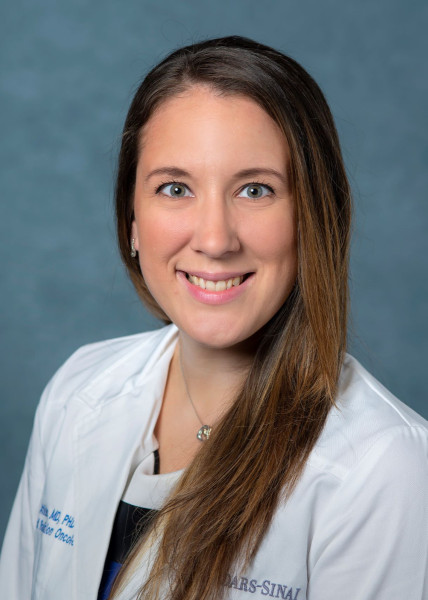 “Dr. Zhang exemplifies the qualities of a successful resident physician and researcher, and it has been a joy to mentor him,” Atkins said. “Not only does he take phenomenal care of patients, but he also patiently teaches and mentors medical students and junior researchers and is a consummate team player.”
Atkins said Zhang also ambitiously chose research projects that required learning several new skill sets, to which he diligently committed.
“The work he presented for this award is part of a larger body of work in cardio-oncology that he has expertly put together and is pushing the leading edge of our field to help shape how we deliver safe and effective care.”
Kim’s original research, “Elucidating the Role of Sensory Cortical Areas in Short-Term Memory,” shows that human sensory cortical neurons and sensory model neurons can perform tasks requiring working memory, suggesting their involvement in complex cognitive functions—contrary to previous understanding—and highlighting potential therapeutic targets for neuropsychiatric and neurodegenerative conditions.
His mentors are Ueli Rutishauser, PhD, professor of Neurosurgery, Neurology and Biomedical Sciences and director of Human Neurophysiology Research and the Center for Neural Science and Medicine at Cedars-Sinai, and Chrystal Reed, MD, associate professor of Neurology and director of the Neurophysiology Fellowship Program.
Liang’s presentation, “Development and Validation of Biomarker Index for Hepatocellular Carcinoma Treatment and Response,” focused on the development of a blood-based test that may be helpful for detecting and monitoring hepatocellular carcinoma, although additional tests are needed to confirm its accuracy. His mentor is Ju Dong Yang, MD, medical director of the Liver Cancer Program at Cedars-Sinai Cancer.
Funding for this year’s event was provided by the Burns and Allen Research Institute and the Clinical and Translational Science Institute at Cedars-Sinai.
Follow Cedars-Sinai Academic Medicine on X for more on the latest basic science and clinical research from Cedars-Sinai.