


Cedars-Sinai Symposium on Women’s Health Research Notes Both Progress and Barriers
Funding for Diseases that Impact Women Still Lags Far Behind Men’s Health Research
Women are not “small men,” and gender inequality in medical science harms everyone, not just women. These were among the topics explored at the fifth annual symposium of the Cedars-Sinai Center for Research in Women’s Health Science (CREWHS), held in Harvey Morse Auditorium on April 9.
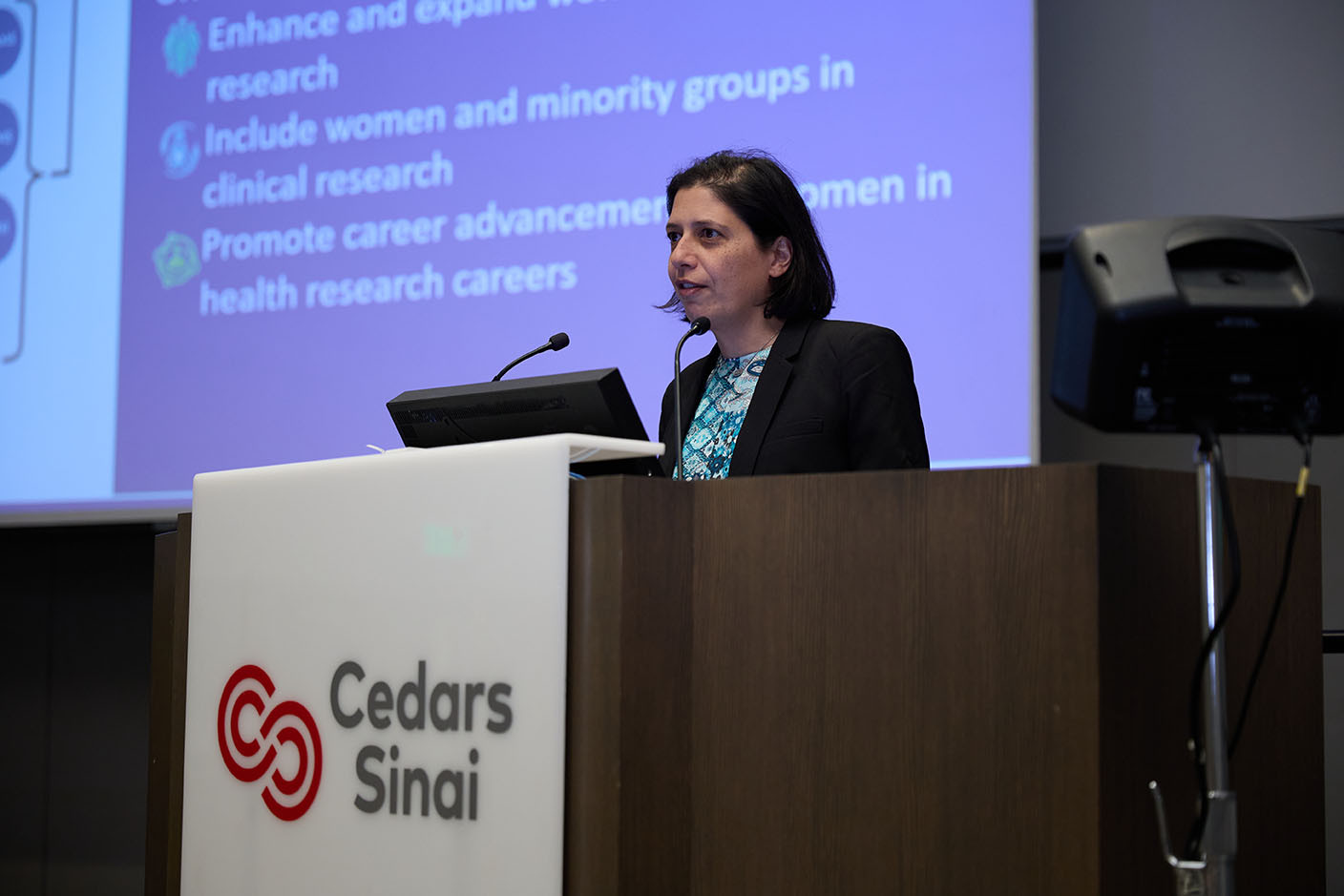
The half-day scientific meeting opened with a presentation on the future of women’s health by Sarah Temkin, MD, the Associate Director for Clinical Research for the Office of Research on Women’s Health at the National Institutes of Health (NIH).
“We’ve understood for decades that women experience health and disease differently and that overall, they have a higher prevalence of diseases and more years lost to illness when compared to men,” Temkin said.
Studies that led to the development of therapies for a wide range of diseases usually left women and their biological differences out of the equation. That began to change in 1993 when the federal government mandated the NIH to include women, and racial and ethnic minorities, in funded trials. Since 2015, the NIH has required that study designs and analyses factor in sex as a biological variable, a term often abbreviated as SABV.
“Gender inequality is bad for the health of women and it’s also bad for the health of men and for society as a whole. The good news is that now, over 50% of our funded research meets that SABV criteria,” Temkin said.
But funding for women’s research remains a significant challenge. In 2023, NIH investments in women’s health amounted to about 10% of its $45 billion budget, with substantially more money spent on conditions that impact men, Temkin said.
“The federal government can play a key role in closing that funding gap by backing its Women’s Health Research initiative with meaningful funding. When you improve women’s health, you also improve the health of their families,” said Sarah Kilpatrick, MD, PhD, who holds the Helping Hand of Los Angeles Chair in Obstetrics and Gynecology and co-leads the CREWHS Steering Committee.
Private fundraising has a key role to play as well, said C. Noel Bairey Merz, MD, director of the Barbra Streisand Women’s Heart Center in the Smidt Heart Institute and co-leader of the CREWHS Steering Committee.
“We need to emphasize the value of private seed funding, which can result in larger federal studies aimed at improving human health, especially in light of the stated commitment of first lady Jill Biden, who visited Cedars-Sinai and saw firsthand the institutional dedication to supporting women’s health research,” Bairey Merz said.
CREWHS’s funding goals for the next three years include seeking federal financing from the Women’s Health Initiative to support training and career development for emerging scientists investigating women’s health and sex differences, said Caroline Jefferies, PhD, an autoimmune disease scientist, associate professor of Medicine and Biomedical Sciences and the scientific director of CREWHS.
During the afternoon sessions, Martha Gulati, MD, director of Preventive Cardiology in the Department of Cardiology in the Smidt Heart Institute, presented her groundbreaking research showing that women get the same exercise benefits as men but with less effort.
“Women are not small men and they have not been studied well at all. But for our investigation, we got some good news for women related to outcomes and physical activity; less is more,” Gulati said.
The symposium concluded with nine investigators presenting results of their sex-differences research as part of the meeting’s “Lightning Talks” competition. The wide range of topics includes autoimmune disease, weight management interventions and gene expression in the human placenta. A monetary award was offered for the best study and presentation. Project scientist Predrag Jovanovic, PhD, received the reward for his investigation of how scents that induce a stress response moderate metabolism based on gender.
CREWHS 2024 Funding
The CREWHS Steering Committee is now accepting research applications for the 2024 CREWHS Awards for pilot projects seeking seed funding for the investigation of women’s health and sex differences. Those selected will receive up to $50,000-$100,000 (direct costs) for a year, with a potential to extend for a second year.
Email [email protected] for more information. Applications are due by Friday, June 14, 2024.
Follow Cedars-Sinai Academic Medicine on X for more on the latest basic science and clinical research from Cedars-Sinai.