


Cedars-Sinai Experts Present at Radiation Oncology Annual Meeting
Radiation Oncologists Available to Comment on Advances in Radiation Medicine and Cancer Care During ASTRO 2026
 Cedars-Sinai radiation oncologists will join more than 10,000 of their peers, discussing the latest advances in radiation medicine and cancer care at the American Society for Radiation Oncology (ASTRO) annual meeting Sept. 26-30 in Boston.
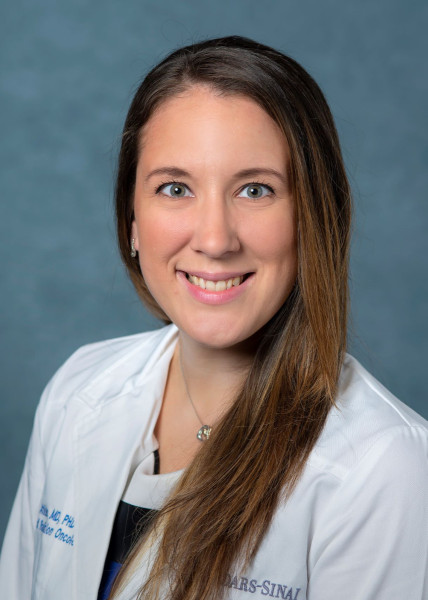
“Our team will be presenting research and clinical trial results, moderating scientific discussions and presenting clinical insights,” said Katelyn Atkins, MD, PhD, interim chair of the Department of Radiation Oncology at Cedars-Sinai Cancer.
Atkins will present research on how the health of the thymus—a small gland in the chest that helps regulate the immune system—affects the risk of heart damage in patients receiving radiation therapy for lung cancer. She also is available to discuss a range of radiation oncology topics.
Additional Cedars-Sinai experts presenting at the conference are available to discuss news coming out of the meeting.
Cedars-Sinai Experts
Leslie Ballas, MD, professor of Radiation Oncology, will present findings from a Phase II multi-institutional study examining whether very low doses of radiation—adjusted based on how each patient responds—can treat bone metastases caused by multiple myeloma. She will also join a panel discussion of radiation therapy guidelines for bladder cancer and localized prostate cancer.
Nikhil Chakravarty, MPH, will discuss whether the timing of GLP-1 inhibitor treatment affects the risk of sudden and serious cardiovascular events, such as heart attack or stroke, in men receiving hormone therapy for prostate cancer.
Indrin Chetty, PhD, director of the Division of Medical Physics, will explain how using AI and other software can improve patient safety and outcomes. Chetty also will moderate a workshop on decision-making surrounding re-irradiation and present in a session on using algorithms and optimization to maximize radiation doses to tumors while sparing healthy tissue.
Tai Dou, PhD, assistant professor of Radiation Oncology, will moderate a discussion of AI-powered planning, delivery and analysis of radiotherapy treatments.
Mitchell Kamrava, MD, is a professor of Radiation Oncology and director of Brachytherapy, in which a radiation source is placed inside the body. He will discuss techniques and outcomes for microboosting—delivering a higher, targeted radiation dose to the most aggressive area of a tumor—in men with prostate cancer.
Anthony Nguyen, MD, PhD, assistant professor of Radiation Oncology and Biomedical Sciences, will moderate a discussion and present research about biomarkers in prostate radiotherapy. At the Radiation Research Society annual meeting the following week in Hawaii, he will present an invited lecture on how radiation modifies the immune system.
Stephen Shiao, MD, PhD, professor of Radiation Oncology and Biomedical Sciences and co-leader of the Cancer Therapeutics Program, will present on the microbiome’s regulation of tumor response to low-dose radiation.
Zachary Zumsteg, MD, associate professor of Radiation Oncology and Biomedical Sciences, will give an oral presentation reporting results from a Phase II prospective clinical trial investigating deintensified chemoradiotherapy following transoral robotic surgery in HPV-associated head and neck cancer.
Media Contact
To schedule an interview with a Cedars-Sinai expert, contact Christina Elston at [email protected] or 626-298-0702.