

Q&A: Advances in Pediatric Neurosurgery for Epilepsy
Cedars-Sinai Guerin Children’s Neurosurgeon David Bonda, MD, Explains How Surgery Can Help Children With Drug-Resistant Epilepsy
Medications are the first line of treatment for children with epilepsy, but sometimes they are not enough to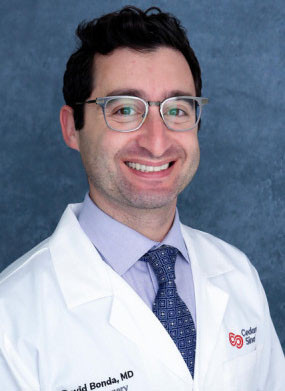 control a child’s seizures. For these patients, neurosurgery can safely reduce—or even eliminate—seizures.
“While medication controls seizures for most patients with epilepsy, drugs are not effective in approximately one-third of children and adults,” said David Bonda, MD, an assistant professor of Neurosurgery specializing in epilepsy at Cedars-Sinai Guerin Children’s. “Once a patient has tried two drugs without success, we immediately consider them for surgery.”
Epilepsy, a chronic neurological condition, affects more than 450,000 children in the U.S., making it the most common childhood brain disorder.
In recognition of November’s Epilepsy Awareness Month, the Cedars-Sinai Newsroom spoke with Bonda about which patients can benefit from neurosurgery for epilepsy and how research and technological advances are improving patient outcomes.
What do you tell patients and families who are hesitant about considering neurosurgery?
I tell them that it is less dangerous to have surgery than it is to continue having uncontrolled seizures. The procedures we perform for epilepsy are extremely effective and safe, so the risks of continued seizures on the developing brain are far greater than the risks of surgery.
I also remind them that epilepsy is a life-threatening disease. Patients with drug-resistant epilepsy have a 40% to 60% greater lifetime risk of dying from their disease compared to those whose seizures are controlled with medication.
What are the surgical options for pediatric patients with epilepsy?
There are three main categories of epilepsy surgery, depending on the type of seizures a patient experiences and where they originate in the brain.
For patients with focal epilepsy, whose seizures appear to originate from a specific area of the brain, we can either remove the affected area or use minimally invasive laser therapy to eliminate it. In some cases, these procedures can completely eliminate seizures.
If we are unable to pinpoint the source of seizures noninvasively using imaging or electrodes attached to the scalp to measure brain activity, we can implant electrodes directly into the brain to identify where seizures begin. This additional information helps determine the most appropriate surgical treatment.
For patients with generalized epilepsy, whose seizures are not coming from one specific area of the brain, neuromodulation may be an option. In this procedure, we implant a device—such as a vagus nerve stimulator—that delivers electrical stimulation to the nervous system to help reduce seizure activity.
How is robot-assisted surgery improving epilepsy treatment?
Robotic technology helps surgeons more efficiently and accurately implant electrodes to identify where seizures originate. The robot acts as a guide, helping us follow planned trajectories and determine the appropriate depth and angle for electrode placement within the brain.
Typically, implanting 25 electrodes without robotic assistance can take eight to 10 hours. With the robot, it takes around four hours. This greatly reduces surgery time and anesthesia exposure for the patient.
What are the latest technological advances in neurosurgery for epilepsy?
One promising advance is closed-loop neuromodulation, where a surgically implanted device continuously monitors brain activity through electrodes placed in the brain. When the device detects abnormal activity associated with seizures, it delivers electrical stimulation to try to stop it.
This technique is continuing to evolve and become more precise based on the patient’s specific seizure networks. So that is going to be a major frontier of improvement.
What is recovery like for pediatric epilepsy patients who undergo neurosurgery?
Parents are always surprised by how well children tolerate surgery. Ideally, patients wake up just as they were before surgery, except without seizures.
Depending on the procedure, patients typically spend one night in the Pediatric Intensive Care Unit before moving to a regular hospital floor. Some go home within two or three days, while others may need a little longer.
After returning home, patients have a few restrictions to allow their incisions to heal, but can generally resume everyday activities, including walking, playing and going back to school.
What research is the Bonda Lab focusing on?
At the Bonda Lab, we study children who have electrodes implanted in their brains while undergoing epilepsy monitoring.
The lab uses specialized research electrodes with tiny micro-wires that can record activity from individual neurons. This allows us to study cognitive functions, such as short- and long-term memory, learning, language, and executive control, while the patient is hanging out in the epilepsy monitoring unit or playing video games that evoke certain brain functions.
This type of single-neuron recording has provided important insights into the adult brain, but very little has been conducted in children.
Guerin Children’s is one of the only centers in the world using single-neuron recordings in pediatric patients. Our goal is to better understand how the brain develops, helping fill critical gaps in pediatric neuroscience and improving understanding and treatment of brain disorders.
Read more from Cedars-Sinai Stories and Insights: New Research Reveals How Memories "Stick"