


New Tool Targets Personalized Presurgical Breast Cancer Care
Cedars-Sinai Scientists Create BRIDGE, Computational Tool to Predict Patient Response and Personalize Presurgical Breast Cancer Treatment
A team led by Cedars-Sinai Health Sciences University investigators has developed a tool for matching breast cancer patients with the most effective presurgical treatments. Called BRIDGE, the tool is the first of its kind and is described in Annals of Oncology.
Breast tumors are currently classified into basic subtypes such as HER2-positive and triple-negative. Based on a tumor’s subtype, doctors can prescribe chemotherapy, immunotherapy or other treatments to shrink the tumor before a patient undergoes surgery to remove it. This can allow some patients to have a lumpectomy rather than a full mastectomy.
 Presurgical treatment, also called neoadjuvant treatment, can also help kill cancer cells that have spread beyond the breast, which can help prevent cancer from returning.
“The issue is that a single breast tumor can include many cancer subtypes, but current tests classify the whole tumor as one,” said Eytan Ruppin, MD, PhD, deputy director of the Translational Research Institute at Cedars-Sinai and co-corresponding author of the study. “With BRIDGE, we use gene activity to measure the various subtypes within a tumor and better pair patients with the most effective presurgical treatment.”
Together with the composition of the tumor, BRIDGE provides a score that tells clinicians how likely a patient is to respond to a given presurgical treatment. The tool analyzes the same tumor biopsy samples physicians routinely take when a patient is diagnosed.
“We addressed the most common presurgical treatments given in the major breast cancer subtypes,” said Thomas Cantore, PhD, a postdoctoral scientist in the Ruppin lab and co-corresponding author of the study. “Applying BRIDGE to data from hundreds of patient samples whose cancer type and treatment response were known, we found that it accurately predicts which patient may or may not respond to which therapy.”
Building on the work of others on Ruppin’s team, the investigators next took BRIDGE a step further.
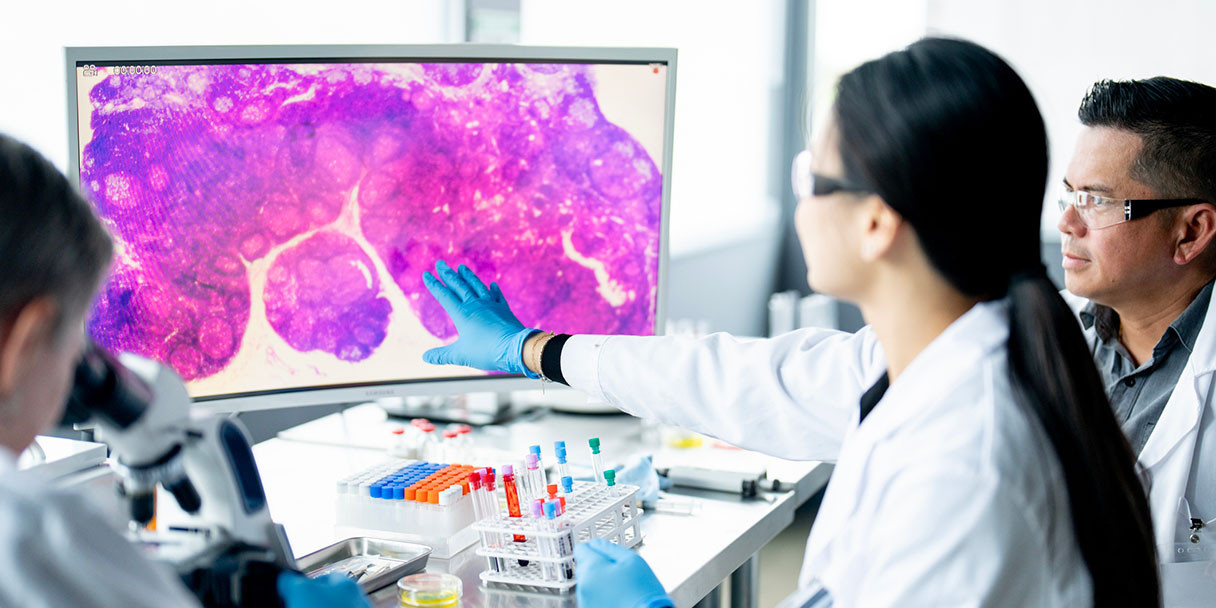
“Our second step was to apply AI tools to BRIDGE to create BRIDGE-Slide,” said Nishanth Ulhas Nair, PhD, a research scientist in the the Jim and Eleanor Randall Department of Surgery and co-corresponding author of the study. “Rather than requiring costly genomic sequencing of the tumor, BRIDGE-Slide can infer the makeup of a tumor from an image of the biopsy slide. This saves time, and thousands of dollars, and could help democratize precision oncology, making personalized breast cancer treatment accessible to all.”
The next step for investigators is to further test BRIDGE and BRIDGE-Slide in clinical trials, Cantore and Nair said.
“These biopsy slides are a gold mine of information,” Cantore said, “and we are focused on leveraging them.”
Additional Cedars-Sinai authors include S.R. Dhruba, E. Campagnolo, J. Levy, K. Yao, I. Liao, and Y. Yuan.
Other authors include D-T. Hoang, L.R. Pal, A. Stemmer, T-G. Chang, E. Shulman, J.S. Lee, S.M. Stemmer, S-J. Sammut, S. Lipkowitz, P.S. Rajagopal, M. Filipits, and C. Caldas.
Funding: This research was supported in part by the Intramural Research Program of the National Institutes of Health (NIH), National Cancer Institute (NCI). The contributions of the NIH author(s) are considered Works of the United States Government. The findings and conclusions presented in this paper are those of the author(s) and do not necessarily reflect the views of the NIH or the U.S. Department of Health and Human Services. This research is partially supported by a grant of the Korea-US Collaborative Research Fund (KUCRF), funded by Ministry of Science and ICT and Ministry of Health & Welfare, Republic of Korea (grant number: RS-2024-00468417). This work used the computational resources of the NIH HPC Biowulf cluster (http://hpc.nih.gov). The results shown here are in part based upon data generated by the TCGA Research Network: https://www.cancer.gov/tcga.
Cedars-Sinai Health Sciences University is advancing groundbreaking research and educating future leaders in medicine, biomedical sciences and allied health sciences. Learn more about the university.