

Cedars-Sinai Blog
Former Dancer's Journey Through Severe Scoliosis Surgery

Milan Brahney was 12 or 13 when she first heard the word “scoliosis.” Before that, she’d had no idea there was anything unusual about her back.
“When I was diagnosed, the doctor said it was only a small curve and to check back in six months,” Brahney remembered. “But when I went back, maybe a year later, the bend was a lot worse.”
In the ensuing years, despite her worsening condition, Brahney built a successful career as a Dallas Cowboys cheerleader and a dancer for the Golden State Warriors.
But this year, at age 28, Brahney finally made the decision to undergo significant surgery on her spine to correct her scoliosis.
“I had transitioned to a desk job after dance, and it really affected my back,” said Brahney. “Without all the movement and training I was used to, it was getting stiffer and more painful. And the curves of my scoliosis were getting more severe, making my right shoulder stick up more.”
To perform the operation, she chose David Skaggs, MD, co-director of Cedars-Sinai Spine and chief of Pediatric Orthopaedics.
“Spinal fusion surgeries to correct scoliosis have been around for decades, and at Cedars-Sinai, we continue to improve the safety and outcomes for patients,” Skaggs said.
After a successful procedure to straighten Brahney’s spine, Skaggs told her she would be able to do, “anything a young, healthy athletic person can.”
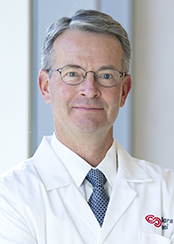
David L. Skaggs, MD
What Is Scoliosis?
Healthy spines are straight when viewed from the front or back. Scoliosis is both a sideways bend and a twisting in the spine, which can eventually lead to arthritis, chronic back pain and difficulty taking a full breath. The condition often starts during childhood but can also develop in adults. Like Brahney’s, most cases are idiopathic, meaning there is no clear cause—though genetics plays a role.
Scoliosis is measured by the number of degrees the spine curves away from being straight.
- A curve of less than 10 degrees is not considered scoliosis.
- Mild scoliosis is 10-24 degrees.
- Moderate scoliosis is 25-44 degrees.
- Severe scoliosis is 45 degrees or more.
Orthopedists generally only recommend surgery for severe scoliosis.
Brahney’s Scoliosis Journey
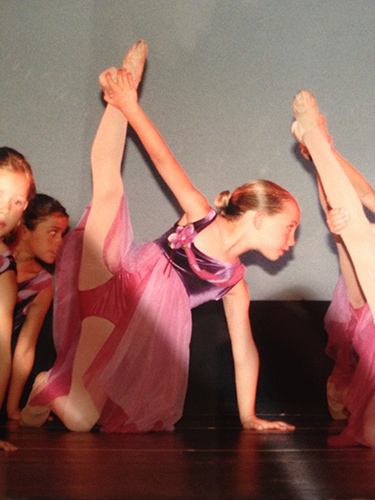
Brahney’s first visit with an orthopedic surgeon happened during her freshman year of high school, in the Bay Area where she grew up.
“I really didn’t like seeing my X-ray,” she said. “I remember looking at it and seeing that I had this crooked spine. Knowing that was inside me was a little scary. And the orthopedist said if it got worse, I might need surgery and I’d have to stop dancing, and dancing was my passion.”
Afraid of what might happen if her back got worse, Brahney and her family decided to combat her condition with chiropractic and Schroth, a form of physical therapy specifically designed for people with scoliosis. Brahney threw herself into the effort, spending as much as two or more hours every day doing exercises and stretches to strengthen and straighten her back, in addition to practicing competitive dance.
Still, the pain impacted her daily life.
“Sitting for a long time was a problem,” she said. “And if we had a sleepover or something, I couldn’t do homework on my bed like the other kids. I had to be in a position that supported my back.”
Brahney says she “pushed the pain under the rug” and hid her condition. She just wanted to be seen as a normal kid.
“I kind of just ignored it, because I was able to dance and do what I loved,” she said.
Moderate scoliosis is not necessarily a hindrance to high-level athletics. Olympic-champion sprinter Usain Bolt and swimmer Janet Evans both have scoliosis, as does retired professional tennis player James Blake. However, severe scoliosis—like Brahney came to develop—is a different story.
A Dallas Cowboy Cheerleader
Brahney went to college at Southern Methodist University in Dallas, Texas—home of the NFL’s Dallas Cowboys and their famous cheerleading squad. While getting a marketing degree with a minor in psychology, she also took dance classes in the city, where she met some cheerleader alumni who encouraged her to try out for the team.
“It’s a really intense process! Hundreds of girls try out—it’s a lot of people’s dream,” Brahney said. “It hadn’t really been mine, but I really missed dance, so I figured I’d give it a go.”
During a full summer of tryouts, Brahney kept her scoliosis in the same place it had been throughout high school: brushed under the rug. She didn’t want it to affect her chances of making the team.
When the seemingly impossible goal of making the team came true, she suddenly had access to some of the best physical therapy in the world.
“The Cowboys’ athletic trainers would work on me,” Brahney said. “I would get therapeutic massages. I went to the chiropractor. And in my mind, when my back hurt, it was because of the rigorous dance and having two jobs as a student and a dancer.”
After college, Brahney moved back to the Bay Area. There, she joined another prestigious and demanding team: the Golden State Warriors’ dance squad.
The team won the NBA championship in 2022, her rookie year.
“It was a once-in-a-lifetime experience to make it all the way through the playoffs,” she said. “And I got a championship ring!”
But the NBA season is longer and has more frequent games than the NFL, and Brahney’s back pain got worse.
“We’d have a practice or a game almost every night of the week, and I was also working full time,” she said. “The style of dance is a lot more hard-hitting and athletic, too. And I feel like I had to work twice as hard as the other dancers.”

It’s Time
In 2024, Brahney ended her time with the Warriors and moved to Los Angeles for work. At the same time, her back was becoming a more significant issue.
“It would start hurting after just five minutes of me sitting down at my desk,” she said. “I went to physical therapy and a chiropractor to try to solve it on my own, but I still kept noticing it more and more.”
Finally, for the first time since high school, she decided to see an orthopedic surgeon, again.
“I had all these fears about scoliosis surgery, like I would end up in a wheelchair or something,” Brahney said. “So, I did a lot of research. I wanted to make sure I was going to the best doctor. Coincidentally, I was living only seven minutes from the Spine Center and Dr. Skaggs.”
“When Milan came to us, she had three curves in her back, the largest of which was severe, at 53 degrees,” Skaggs said. “Left untreated, it would continue to get one degree worse every year for the rest of her life—eventually leaving her with a huge bump on her back, unable to take a full breath and in a lot of pain.”
Cedars-Sinai is one of the few large medical centers at which the orthopedic and neurosurgical departments work together. All patients benefit from the combined wisdom of a panel of surgeons that meets regularly to discuss the details of elective procedures. Skaggs recommended posterior spinal fusion for Brahney, and the panel agreed.
“My dad flew down to come to that first appointment, and we were blown away,” Brahney remembered. “Dr. Skaggs took a lot of time to talk to us and answer every question. He’s just so positive, and he has a real athlete mindset. He got me looking forward at all the ways my life would improve.”
Scoliosis surgery is an elective procedure, but after meeting Skaggs, Brahney felt confident it was her best option.
“Seeing how bad my spine was on the X-ray and hearing it would get worse every year for the rest of my life, it was kind of a no-brainer,” she said. “My dad and I walked out of his office and then called back 30 minutes later and said, ‘Hey, can we schedule, because I don't want to wait any longer.”
Scoliosis Surgery
For Brahney, the anticipation was worse than the surgery itself.
“Dr. Skaggs is world-renowned, so he has a big waitlist, and I had to wait a couple months,” she said. “That was really hard, because once I’d decided to get the surgery, I just wanted it to happen right away.”
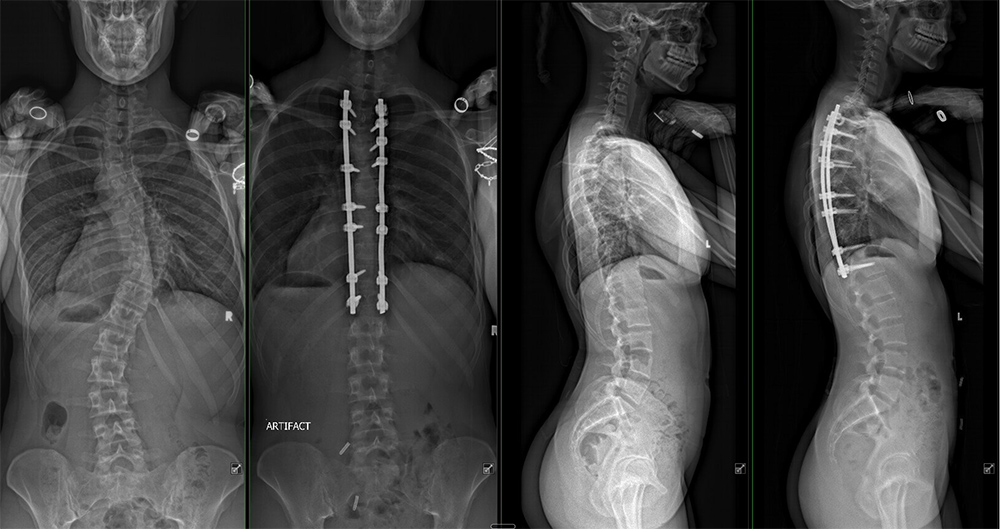
When the day finally came for Skaggs to correct Brahney’s scoliosis, he made a single incision—just over ten inches long—down the midline of her back. Through this approach, he placed titanium screws roughly a quarter-inch wide and 1.5 inches long into the vertebrae.
“These are titanium screws, and they must be placed with millimeter precision,” said Skaggs. “It’s a fine art. You want a surgeon who has done it thousands of times and knows how to get it right.”
Skaggs and his assistant then gradually and safely straightened Brahney’s spine, and the team secured it with cobalt-chrome rods contoured to match the spine’s natural shape.
The surgery was a success, and eventually, Brahney’s vertebrae will fuse together, supported by the screws and rods.
The Result
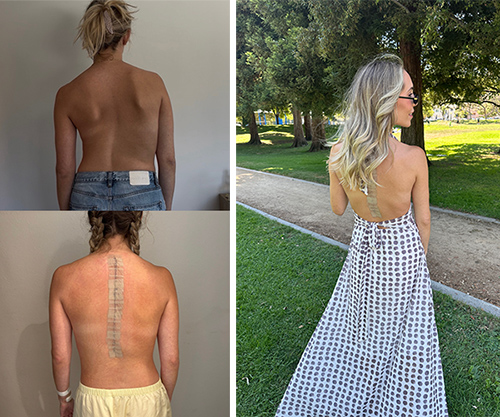
Brahney woke up after surgery happy and wiggling her toes.
“They immediately did an X-ray of my back lying down,” she said. “I was really out of it, but I remember looking at it and thinking, ‘Oh my gosh, that’s my spine. It’s straight!’”
Since the surgery, Brahney has been coming to terms with all the years she suffered.
“It’s crazy that for so long, I just pushed through the pain and unhappiness with my condition,” she said. “I didn't really notice how much it affected me until it was better.”
By straightening her spine, Skaggs also de-rotated Brahney’s ribs and fixed the asymmetries in her shoulders.
“I'm so much more confident in my body now,” she said. “I like wearing open back tops and showing off my scar.”
Brahney still has months of physical therapy before she regains full strength and flexibility. But already at her two-week postoperative appointment, Skaggs told her she was free to do whatever she wanted.
Her advice to others with scoliosis?
“Don’t sweep it under the rug, because if you’re like me, it’s something that you naturally want to push down and not deal with,” she said. “But I wish I had gotten more checkups, because it’s better to know what’s going on and know what your options are. And now, I’m just so glad I got this done!"
Frequently Asked Questions
What is scoliosis?
Scoliosis is a sideways bend in the spine when viewed from the front or back, often causing a twisting of the ribcage. It can cause uneven shoulders and hips, rotated ribs, and in severe cases, difficulty breathing.
What causes scoliosis and why does it worsen over time?
Most scoliosis is idiopathic, meaning the cause is unknown. It can be the result of neuromuscular diseases such as muscular dystrophy and cerebral palsy. Genetics can also play a role, as well as degeneration of the spine with age. Scoliosis in childhood does not always progress, but in adulthood, it will generally get worse by about one degree a year until it reaches a critical threshold of 45 degrees.
When do doctors recommend scoliosis surgery?
Doctors generally recommend corrective surgery to straighten the spine once the curve reaches 45-50 degrees.
What are the treatment options before surgery?
Depending on their maturation and the degree of their curve, children diagnosed with scoliosis may be fitted with a brace that helps prevent the curve from getting worse.

