Matters of the Heart: Rose Tompkins, MD
Date
February 8, 2020
Credits
Date
February 8, 2020
Credits
Medical providers featured in this article
In Brief
{{cta-block}}
As we approach Valentine’s day, we asked Smidt Heart Institute experts to weigh in on the biggest cardiology game-changers to date, as well as the next cardiology breakthroughs. And because nonexperts tend to associate the heart with this anatomically inaccurate emoji and all things pitter-patter—they told us their favorite love stories as well.
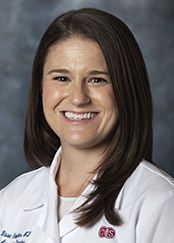
Rose Tompkins, MD
Associate Director, Adult Congenital Heart Program
Smidt Heart Institute
Expertise
Just a few decades ago, Rose Tompkins, MD, wouldn’t have had her current job. As she explains, "The population I care for didn’t exist 70 years ago." She’s referring to patients born with congenital heart anomalies—the most common birth defect—who rarely survived into adulthood. But now, thanks to tremendous advances in cardiovascular care, more children with these conditions survive into adulthood, and Tompkins is among the first cohort of subspecialists specifically trained to care for them.
Game-changer
"Within cardiology, adults with congenital heart defects are the most complex patients," Tompkins says. Establishment of congenital heart disease as a subspecialty of cardiology marked a sea change for precision care of heart patients. "Advanced training is needed to properly care for these patients. I can improve the quality of their lives and follow them through marriages, pregnancies and hopefully even grandchildren."
Next breakthrough
Cedars-Sinai is leading a multisite, national clinical trial for those born with malformed pulmonary valves—a common congenital heart defect that typically requires multiple open-heart surgeries. A new, minimally invasive technique designed to replace the malformed valve with a transcatheter valve is being tested, with the goal of preventing future open-heart surgeries.
Favorite love story
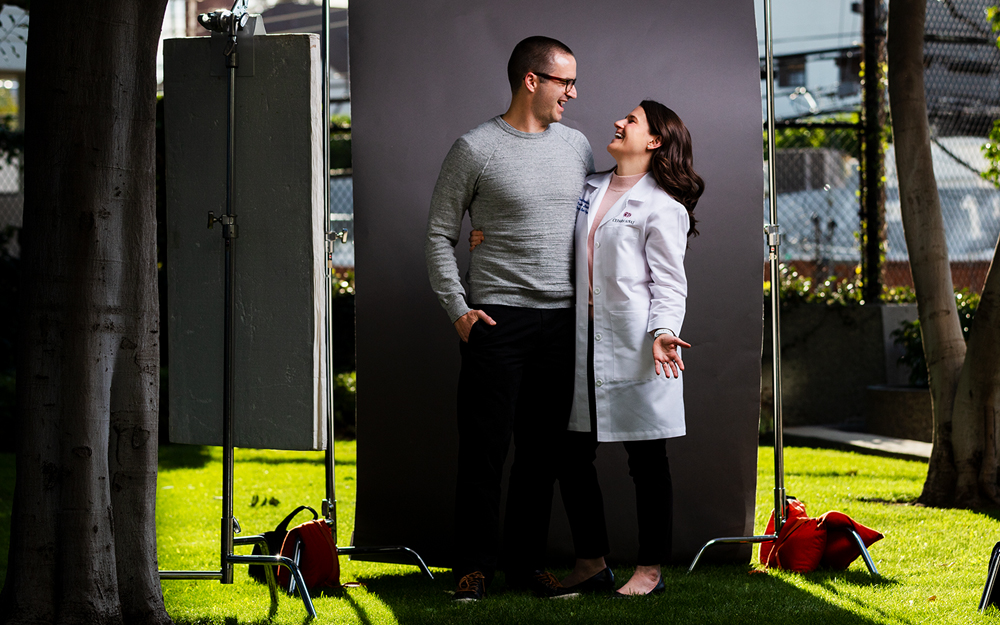
Her own. Tompkins and her now husband met as freshmen at the University of North Carolina at Chapel Hill. She attributes her professional success to her spouse’s unwavering support. "He told me to follow my passion and never complained throughout the years of extra training and the many times we had to move," Tompkins says. "I feel like a guardian angel sent him to me."
More in the Matters of the Heart series:
C. Noel Bairey Merz, MD, Jignesh Patel, MD, Ali Azizzadeh, MD, Janet Wei, MD, Evan Zahn, MD, Alfredo Trento, MD, Joanna Chikwe, MD