Purposeful Relationships to Advance Stroke Science
Date
July 9, 2026

Date
July 9, 2026
Medical providers featured in this article

In Brief
At Cedars-Sinai, mentorship transcends individual research questions; it builds a pipeline of scientists equipped to continue the work.
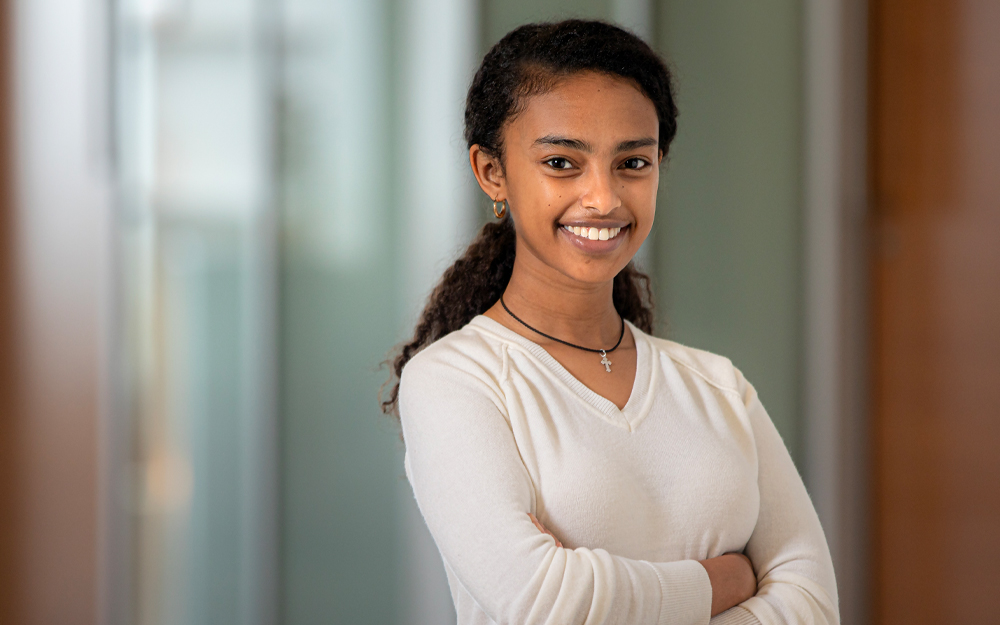
By pairing scientific independence with intentional mentorship, Director of Stroke Research Alexis Simpkins, MD, PhD, has built a model that accelerates discovery, develops future leaders and ultimately improves patient outcomes. For PhD candidate Ada Tadeo, the experience has been both rigorous and rewarding.
Below, Simpkins and Tadeo discuss what makes their mentor-mentee partnership work—and how it reflects Cedars-Sinai Health Sciences University’s broader approach to training.
Discoveries: Dr. Simpkins, what drew you to stroke research—and mentorship?
Simpkins: I’ve always been motivated by gaps, especially in stroke care. I watched family members navigate the devastating effects of stroke at a time when treatment options were limited, and that has stayed with me.
Stroke remains the leading cause of disability worldwide, with incidence rising among younger patients. Addressing it requires a deeper understanding of what happens during the acute phase and a stronger ability to predict outcomes. Connecting pathology to biology is essential for identifying better drug targets and testing therapies before they reach clinical trials.
Advancing the science requires us to build the pipeline by training researchers with the skills to move the field forward.
Discoveries: Ada, what led you to Cedars-Sinai and the Simpkins Laboratory?
Tadeo: My background is in biomedical engineering, and I began my training in traditional wet-lab research. I wanted to move closer to work that directly affects patients. That translational focus is what drew me to Cedars-Sinai.
Dr. Simpkins’ work at the intersection of neuroscience, cardiovascular disease and stroke stood out as an opportunity to work across disciplines while staying grounded in clinical results.
Discoveries: How does the Simpkins Laboratory environment create a culture of success?
Simpkins: My goal is to create an environment where learners flourish and trainees can execute on their ideas to advance patient care. Trainees need access to data, collaborators and infrastructure—but also culture. Rigor and reproducibility matter, but what’s also important to me is creating a space that emphasizes team science, open communication and psychological safety.
Tadeo: Dr. Simpkins’ lab provides structure to support the lab’s vision and freedom to take ownership of my project. That balance has helped me grow as an independent scientist.
My goal is to create an environment where learners flourish and trainees can execute on their ideas to advance patient care.
Discoveries: Ada, can you describe your research on stroke phenotyping and prediction?
Tadeo: We’re trying to understand why some patients regain their independence after a stroke and others don’t, defining them as distinct phenotypes and linking them to molecular and imaging biomarkers.
One focus is automating infarct volume measurements from MRI. Traditionally, this process takes hours. But with AI, we can do it in seconds. We’re also building predictive models that could simulate clinical outcomes and help identify which patients may benefit most from specific therapies.
Discoveries: How does this mentorship model benefit patients?
Simpkins: We can’t lose sight of why we’re doing this work. We’re not just studying populations; we’re trying to improve outcomes for real people. Mentorship is part of that mission. It creates a collaborative environment where investigators are trained to translate knowledge into impact.
Tadeo: There’s a strong sense of purpose behind everything we do. At the end of the day, the goal is to improve lives, and being part of that, even as a trainee, is incredibly rewarding.