
Anatomy and Function of the Coronary Arteries
Detailed information and illustrations about the two coronary arteries, which supply blood to the heart muscle.
On this page
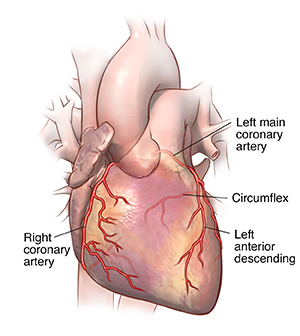
Coronary arteries send blood to the heart muscle. All tissues in the body need oxygen-rich blood to function. The heart muscle also needs it. And oxygen-depleted blood must be carried away. The coronary arteries wrap around the outside of the heart. They send oxygen-rich blood into the heart's muscle tissues.
Two coronary arteries
The two main coronary arteries are:
- Left main coronary artery. This artery sends blood to the left side of the heart muscle. This includes the left ventricle and left atrium. It divides into these branches:
- Right coronary artery. This artery sends blood to the right side of the heart. This includes the right ventricle, the right atrium, and the SA (sinoatrial) and AV (atrioventricular) nodes. These nodes control the heart rhythm. The right coronary artery divides into smaller branches. One is the right posterior descending artery. The other is the acute marginal artery. It also helps send blood to the middle (septum) of the heart.
Problems with the coronary arteries
Since coronary arteries send blood to the heart muscle, any coronary artery problem can cause serious health problems. It reduces the flow of oxygen and nutrients to the heart muscle. This can lead to a heart attack and possibly death. The most common cause of heart disease is atherosclerosis. This is a buildup of plaque in the inner lining of an artery. It causes the artery to become narrow or blocked, so that less blood can get to the heart tissues.
Care and Services
Explore the care options and services we offer at Cedars-Sinai.
Were always here to help.
Get in touch with us by calling 1‑800-CEDARS-1 (1‑800-233-2771) , Monday‑Friday, 8 am‑5 pm PT or feel free to send us a message.