
About the Heart and Blood Vessels
Detailed anatomical description of the heart's blood vessels, including simple definitions and a labeled, full-color illustration.
On this page
The heart is the hardest working muscle in the human body. Located almost in the center of the chest, a healthy adult heart is the size of a clenched adult fist. By age 70, the human heart will beat more than 2.5 billion times. The heart is always working. It pumps about 2,000 gallons of blood daily.
A child's heart works just as hard as an adult's heart. In fact, at rest, a baby's heart may beat up to 130 to 150 times a minute. An adult's heart often beats between 60 and 100 times a minute, at rest. The rate at which the heart pumps gradually slows down from birth to teen years.
The cardiovascular system is made up of the heart and blood vessels. It circulates blood throughout the body. A healthy cardiovascular system is vital to supplying the body with oxygen and nutrients.
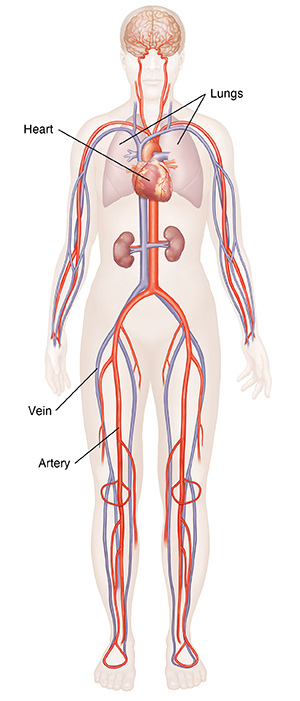
How the heart works
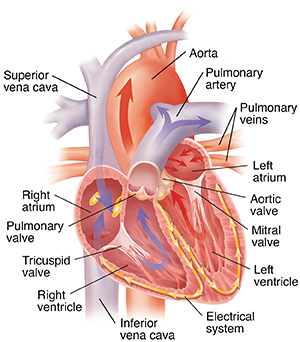
The heart is a large, muscular organ that pumps blood filled with oxygen and nutrients through the blood vessels to the body tissues. It's made up of:
- 4 chambers. The 2 upper chambers are the atria. They receive and collect blood. The 2 lower chambers are the ventricles. They pump blood to other parts of your body. Here is the process:
- 4 valves. The 4 valves are the aortic, pulmonary, mitral, and tricuspid valves. They let blood flow forward and prevent the backward flow.
- Blood vessels. These bring blood to the lungs, where oxygen enters the bloodstream, and then to the body:
- An electrical system that stimulates contraction of the heart muscle.
A network of arteries and veins also carry blood throughout the body:
- Arteries transport blood from the heart to the body tissues.
- Veins carry blood back to the heart.
Care and Services
Explore the care options and services we offer at Cedars-Sinai.
Were always here to help.
Get in touch with us by calling 1‑800-CEDARS-1 (1‑800-233-2771) , Monday‑Friday, 8 am‑5 pm PT or feel free to send us a message.